


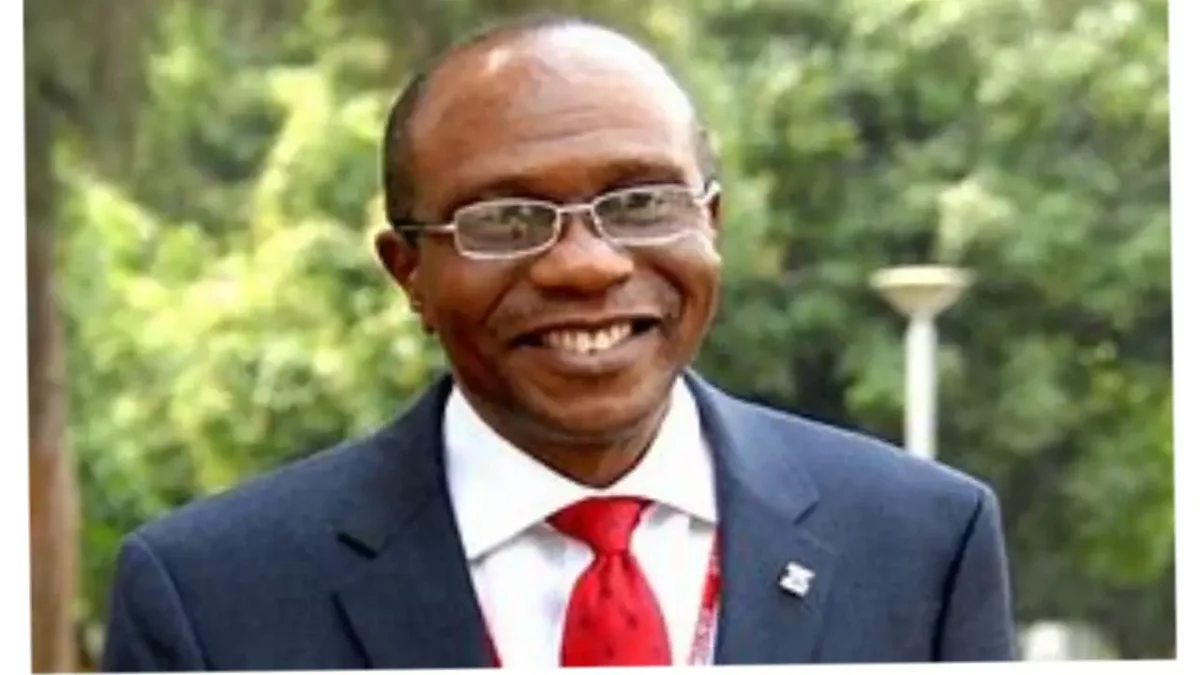
Justice Rahman Oshodi of the Special Offences Court in Ikeja, on Tuesday, December 2, 2025 admitted as evidence, extra-judicial statement tendered by the Economic and Financial Crimes Commission, EFCC, to the effect that the statements of Henry Omoile, co-defendant of the embattled former Governor of Central Bank, Godwin Emefiele, being prosecuted by the agency were voluntarily rendered.
Emefiele alongside Omoile (the second defendant) are being prosecuted by the EFCC over a-19 count charge offences bordering on the alleged abuse of office, $4.5 billion and N2.8 billion fraud.
It would be recalled that, the second defendant had through his counsel, Adeyinka Kotoye, SAN, challenged the admissibility of his statements tendered by the EFCC on the ground that, the statements were not voluntarily obtained.
Therefore, the court adjourned till December 2, 2026 for a trial-within-trial.
The trial-within-trial commenced at noon as Alvan Grumnaan, the Head of Special Duty 77 (Special Operations Team) who claimed to have investigated the defendants denying taking the statements of the second defendant under duress as he told the court that, all the statements were given voluntarily and conducted in a professional manner.
At the proceeding of the mini trial on Tuesday, counsel to EFCC, Rotimi Oyedepo, led the operative of the Commission, Grumnaan, in evidence.
Grumnaan, told the court that, he was an operative attached to the Special Operations Team of EFCC.
According to him, “The statement of the second accused (Henry Omoile) was not attested because the second defendant didn’t confess to an offence.
He explained to the court that attestation are done when a defendant makes a confessional statement during interrogation, following which such would then be taken to a superior officer.
Henry Omoile objection shocks me – EFCC Investigator
Reacting to the objection raised to the extra-judicial statement of the second defendant at the last adjourned date, the prosecution witness said “My reaction is that of surprise and I was shocked that that would come up.
He told the court “That allegation that the statement was recorded involuntarily was shocking because we followed all the rules.
“The second defendant readily gave his evidence both on the first and second date and didn’t raise any issue.
The witness further explained how Omoile made his statements at the Block A, EFCC Lagos Directorate, Awolowo Road, Ikoyi Commission’s conference room, located on the first floor.
He gave a description of the setting as an open, spacious conference room used by the Special Operations Team.
Grumnaan said he was surprised that Omoile later objected to the statements because he appeared at the EFCC office on February 26, 2024 with the Acting Managing Director of Nigeria Inter-Bank Settlement System Plc, NIBSS, and his lawyer, Mr. E. N. Offiong.
According to the witness, “EFCC operatives are trained to take statements without threat or duress. The statements were taken openly. There is no way we could have done that under threat”.
The court admitted four statements as Exhibits 1-4 in the mini trial. Three were taken on February 26, 2024, and one on February 27, 2024.
The witness confirmed that Omoile was in custody when he made them.
He added that the standard practice is to caution suspects before taking their statements. The cautionary words were administered by Mr. Azeez Ajigbotosho, a member of his team.
“The statements were signed by the second defendant.
He wrote, “I am making this statement in the presence of my lawyer, Offiong.”
Although one of the statements did not expressly reflect the presence of the lawyer, the witness highlighted it was an oversight on the part of the defendant but stated that Barrister Offiong was present on both days of taking his statements and tendered the EFCC Visitors’ Register as evidence.
Under cross-examination, by the Defence Team by both Olalekan Ojo, SAN, and Kotoye Adeyinka, SAN respectively, the witness admitted that there was no video recording of the defendant’s statement, despite it being part of the standard procedure.
He cited challenges of logistics, that certain circumstances sometimes make video recordings impossible.
Following the evidence, Justice Oshodi discharged the witness and adjourned the continuation of the trial-within-trial to January 15 and 16, 2026.
